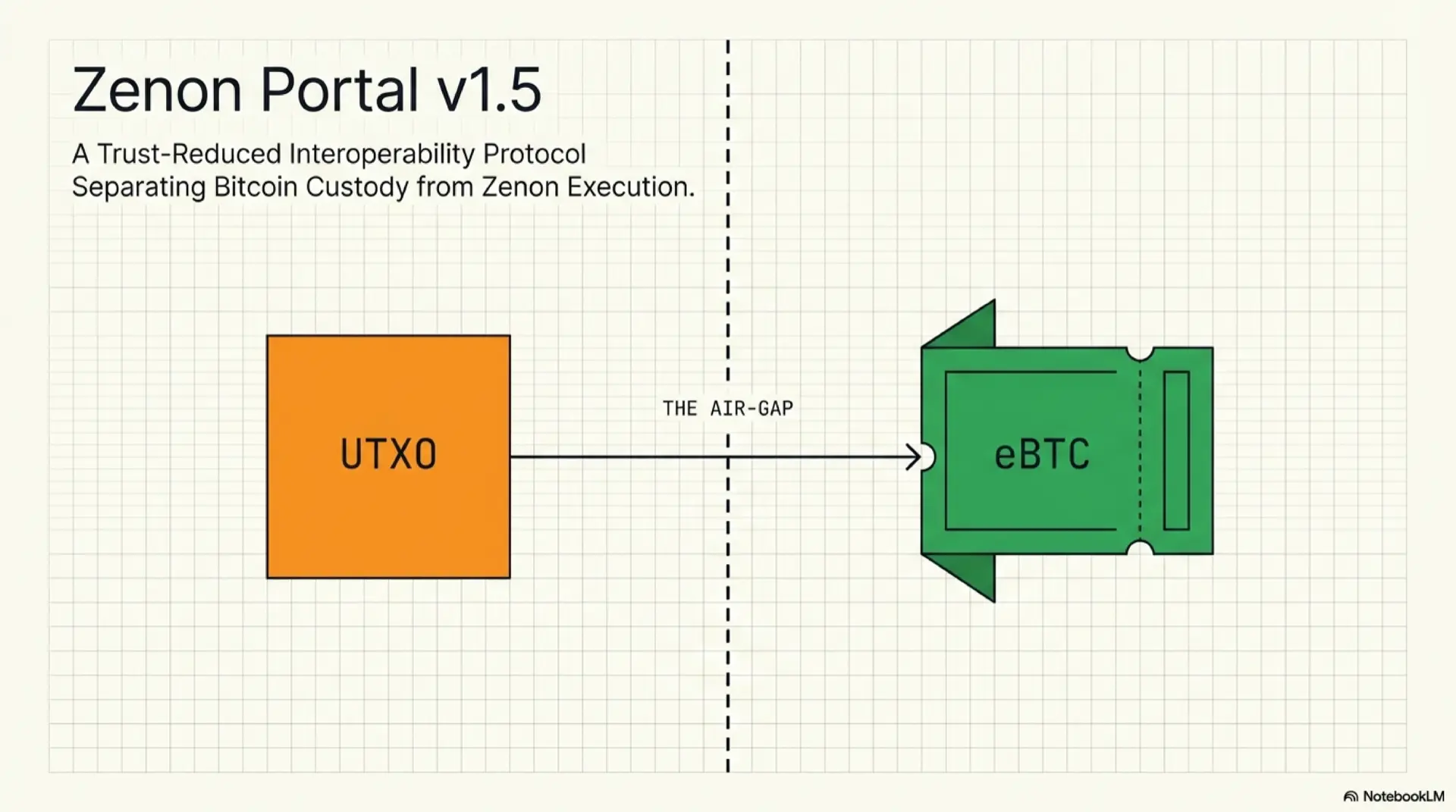
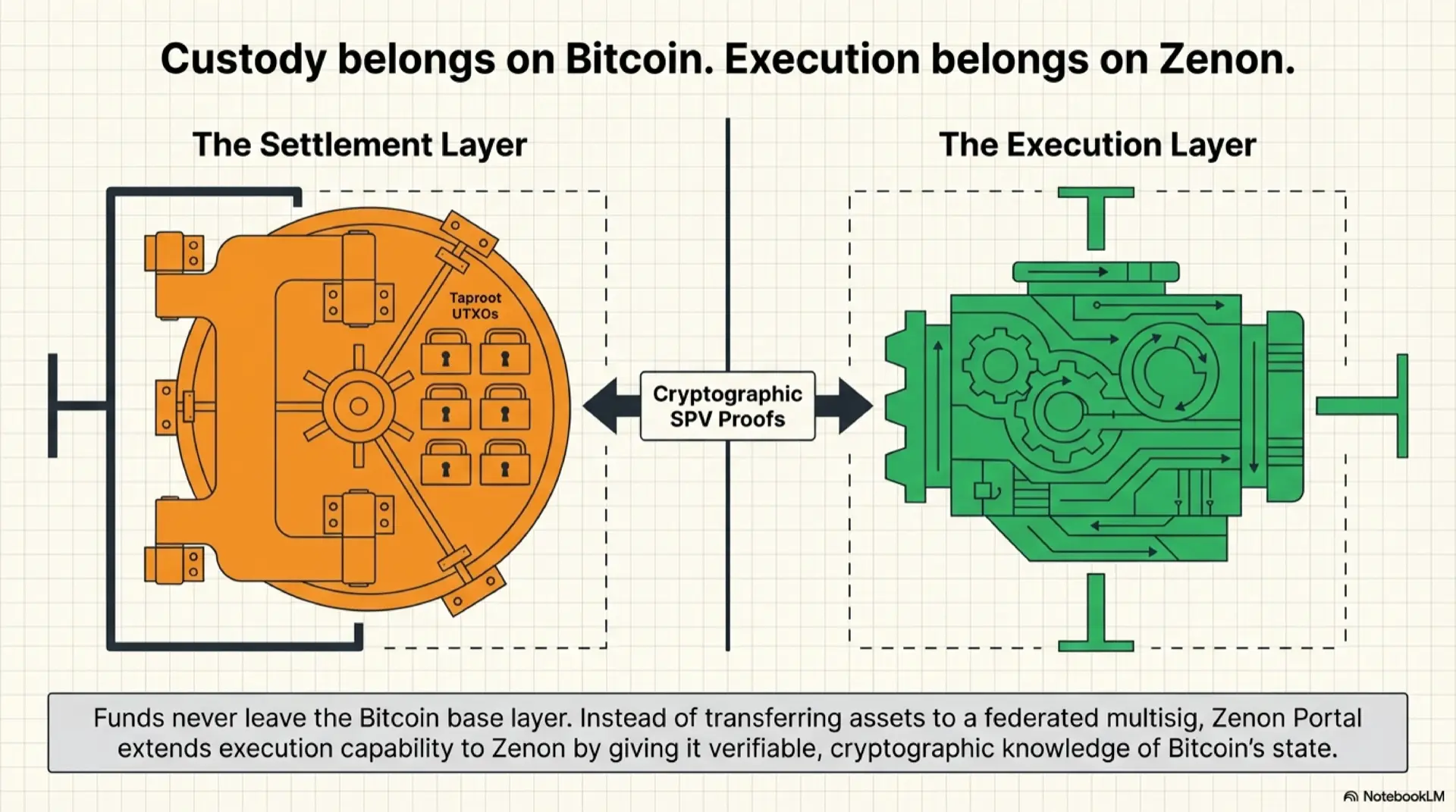
Zenon Portal v1.5 is a trust-reduced interoperability protocol that separates Bitcoin custody from Zenon execution. Funds never leave the Bitcoin base layer. Instead of transferring assets to a federated multisig, Zenon Portal extends execution capability to Zenon by giving it verifiable, cryptographic knowledge of Bitcoin's state through SPV (Simplified Payment Verification) Merkle inclusion proofs.
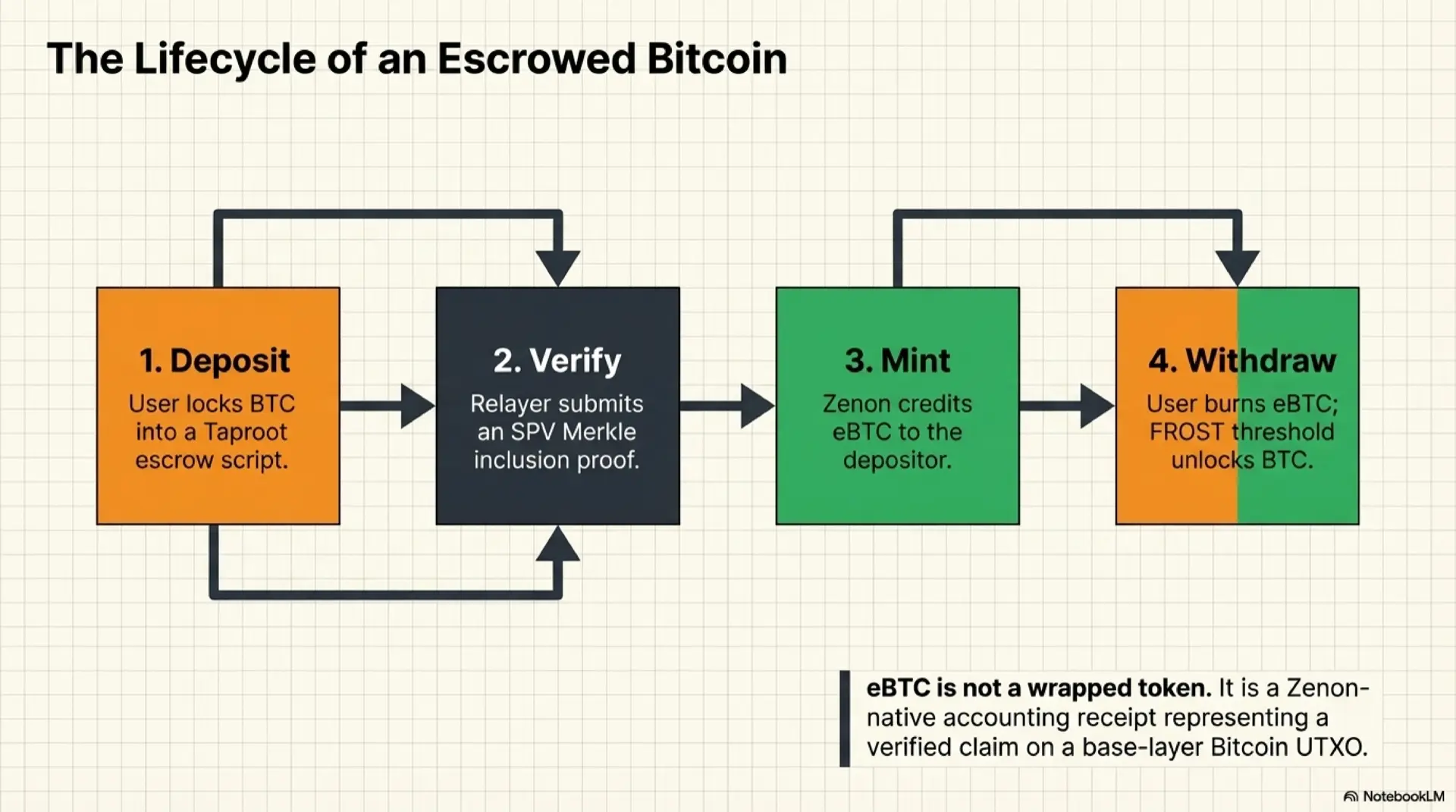
1. Deposit: User locks BTC into a Taproot escrow script. 2. Verify: Relayer submits an SPV Merkle inclusion proof. 3. Mint: Zenon credits eBTC to the depositor. 4. Withdraw: User burns eBTC and a FROST threshold signature unlocks the BTC. eBTC is not a wrapped token — it is a Zenon-native accounting receipt representing a verified claim on a base-layer Bitcoin UTXO.
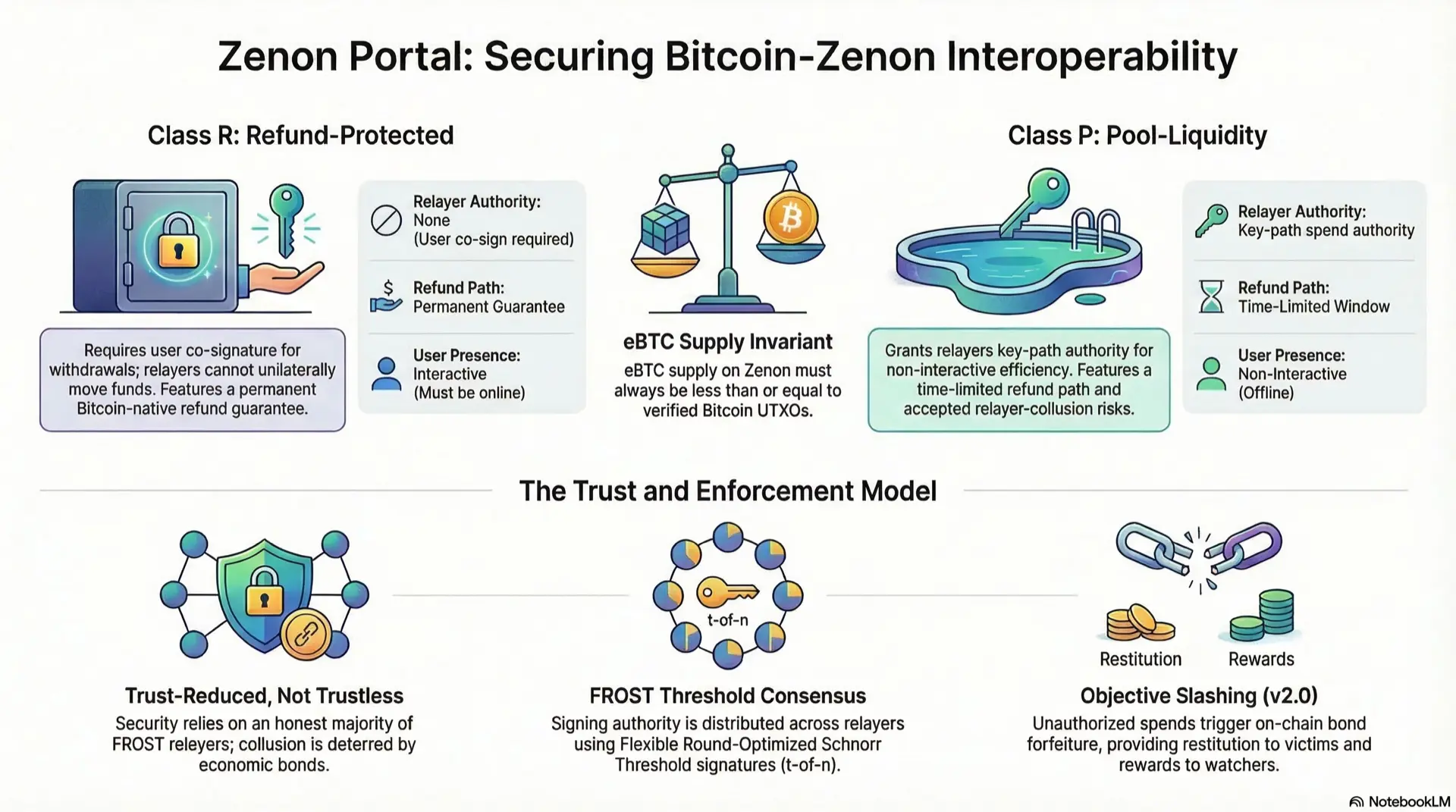
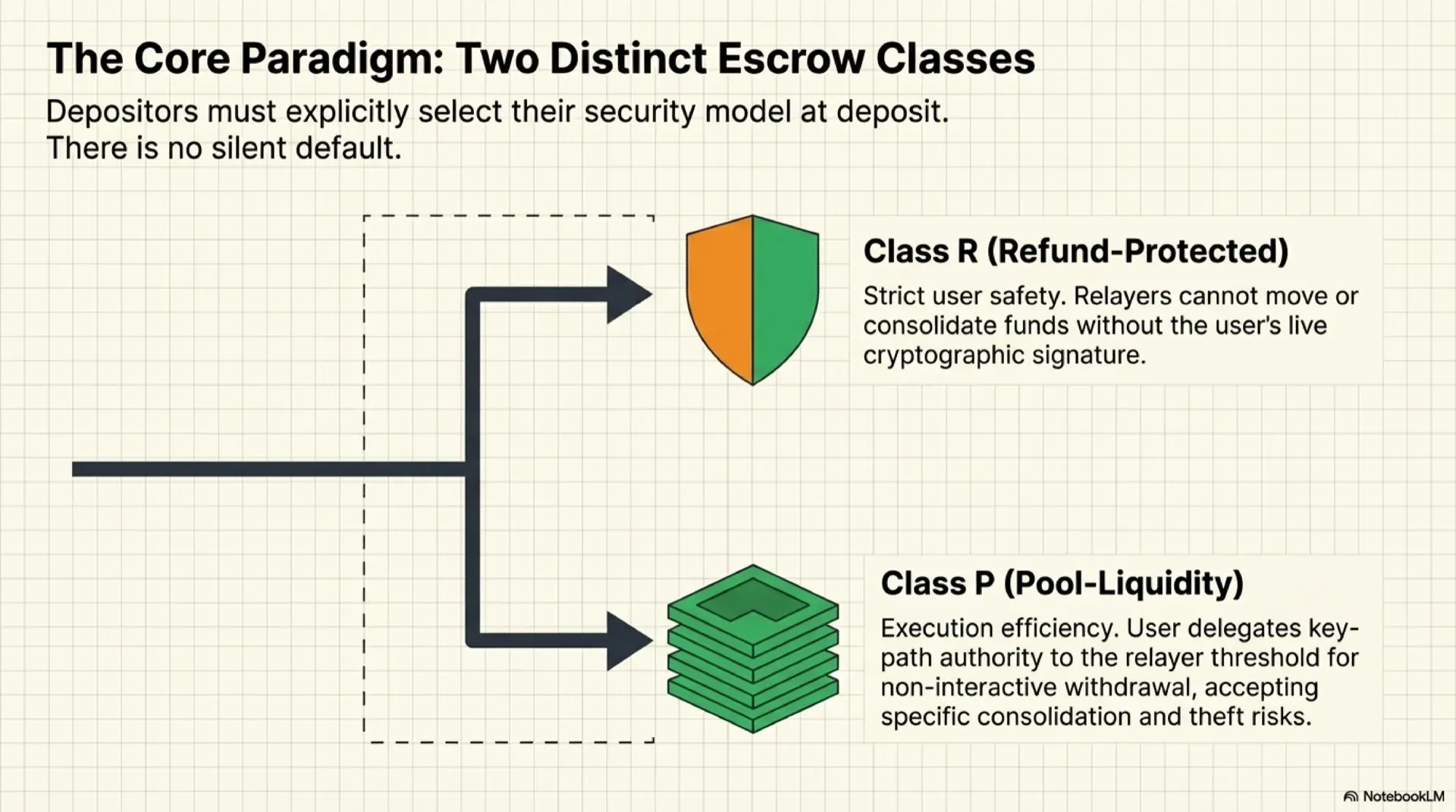
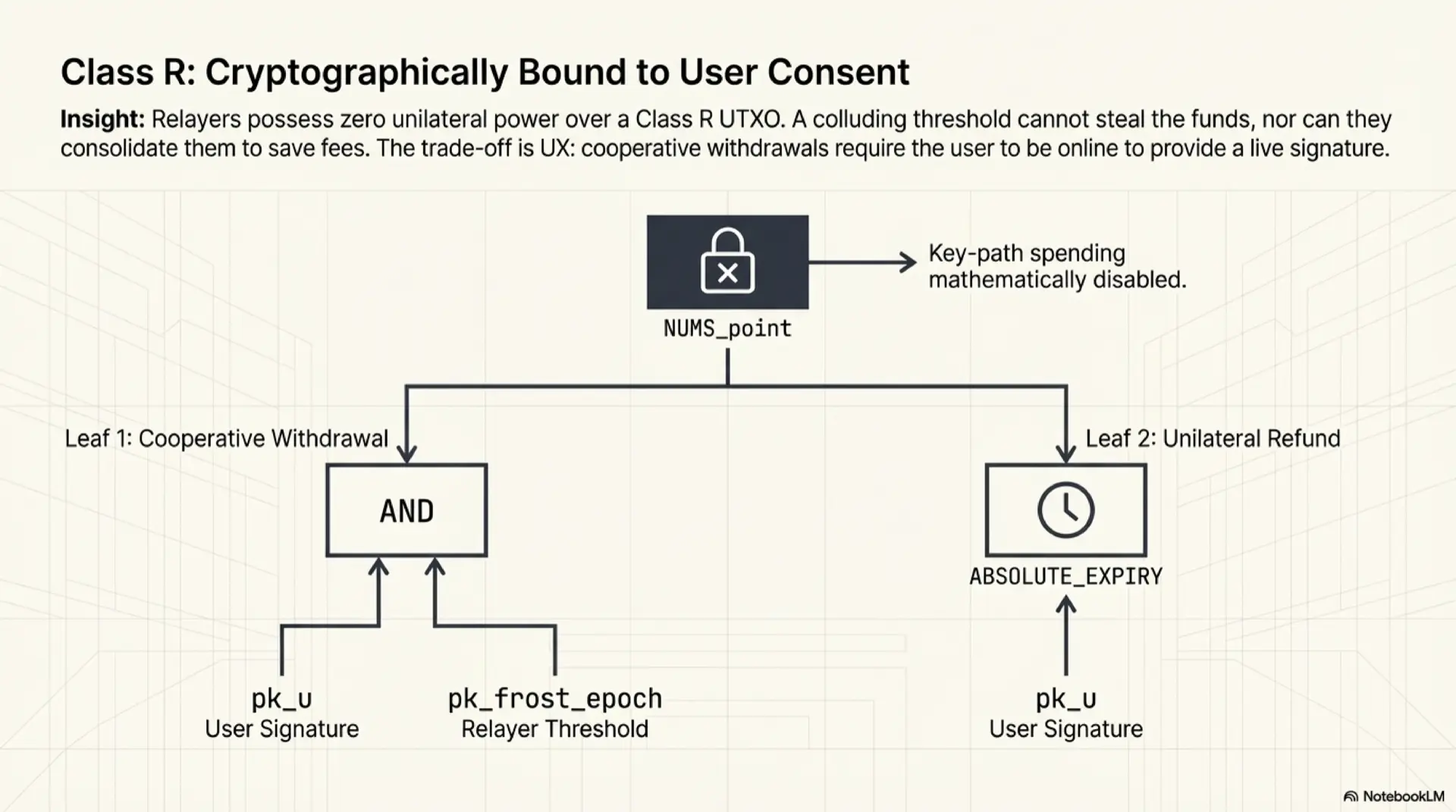
Class R (Refund-Protected): Strict user safety. Relayers cannot move or consolidate funds without the user's live cryptographic signature. Key-path spending is mathematically disabled via a NUMS point. Withdrawal requires both the user signature (pk_u) and the relayer threshold (pk_frost_epoch). A unilateral refund leaf allows the user to reclaim funds after ABSOLUTE_EXPIRY using only their own key.
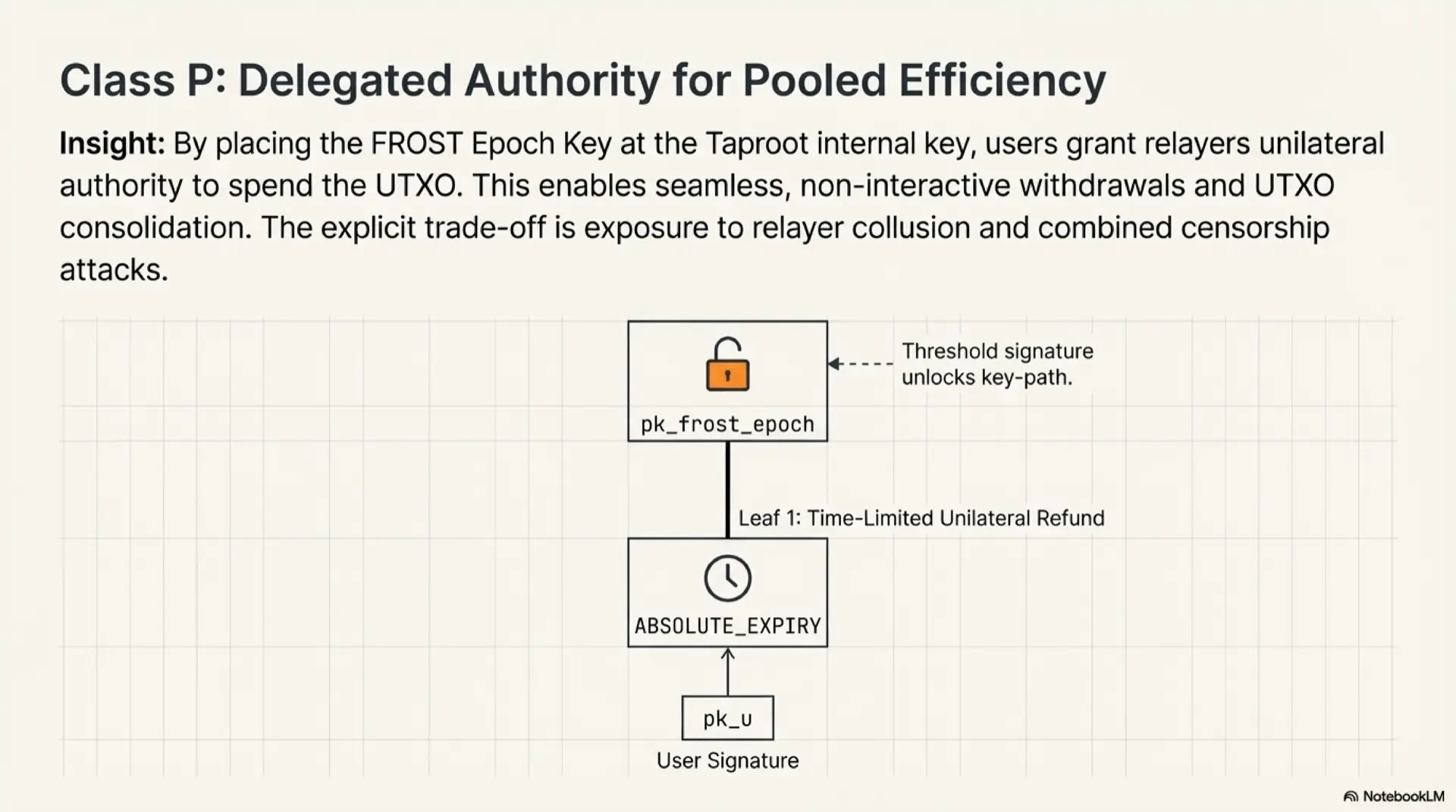
Class P (Pool-Liquidity): Execution efficiency. The FROST Epoch Key is placed at the Taproot internal key, granting relayers unilateral authority to spend the UTXO. This enables seamless, non-interactive withdrawals and UTXO consolidation. The trade-off is exposure to relayer collusion and combined censorship attacks. A time-limited unilateral refund leaf provides a fallback exit.
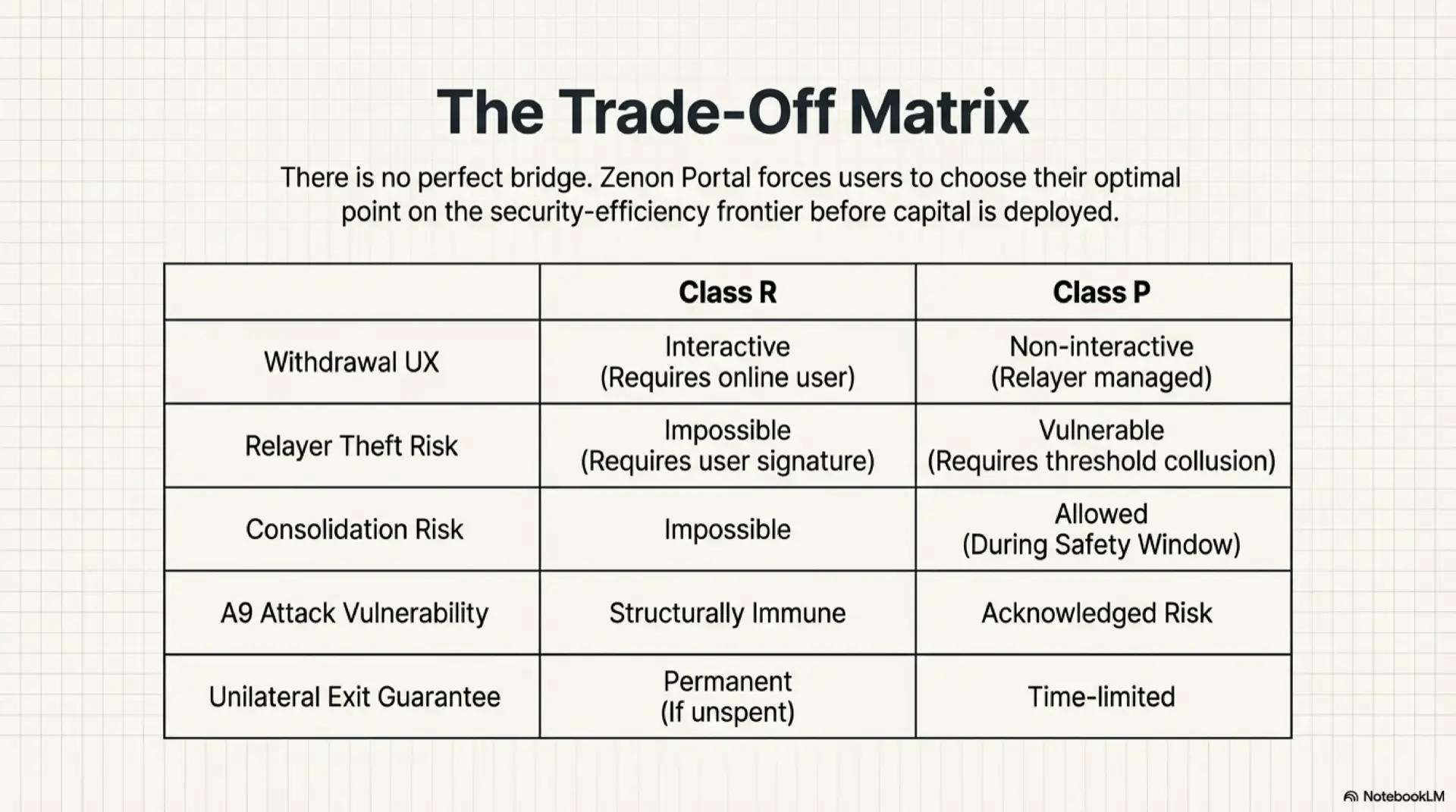
Withdrawal UX: Class R requires the user to be online (interactive), Class P is relayer-managed (non-interactive). Relayer Theft Risk: Impossible for Class R (requires user signature), Vulnerable for Class P (requires threshold collusion). Consolidation Risk: Impossible for Class R, Allowed for Class P during the Safety Window. A9 Attack Vulnerability: Class R is structurally immune, Class P has acknowledged risk. Unilateral Exit Guarantee: Permanent for Class R (if unspent), Time-limited for Class P.
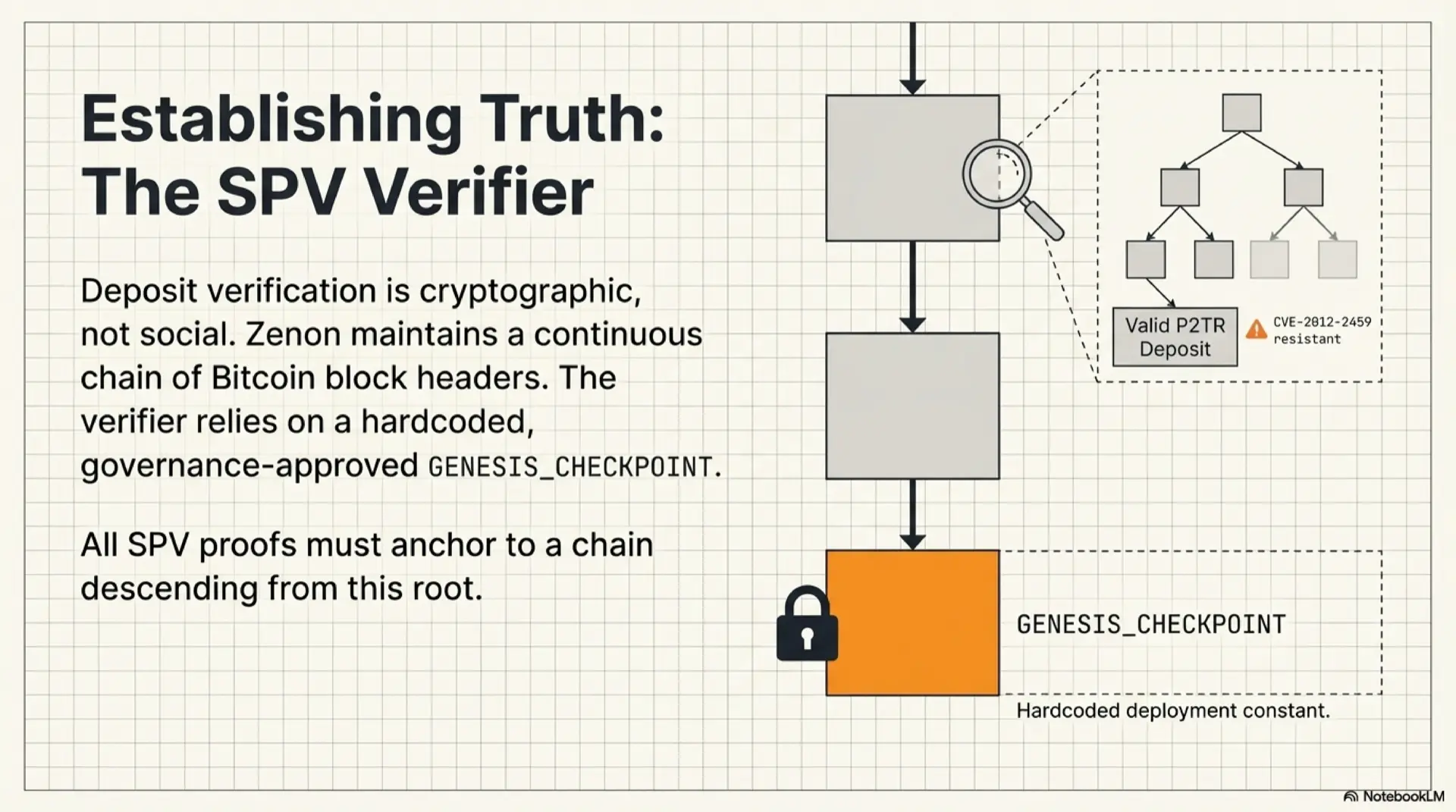
Deposit verification is cryptographic, not social. Zenon maintains a continuous chain of Bitcoin block headers. The verifier relies on a hardcoded, governance-approved GENESIS_CHECKPOINT. All SPV proofs must anchor to a chain descending from this root. Deposits must be valid P2TR (Pay-to-Taproot) transactions and are checked for CVE-2012-2459 resistance.
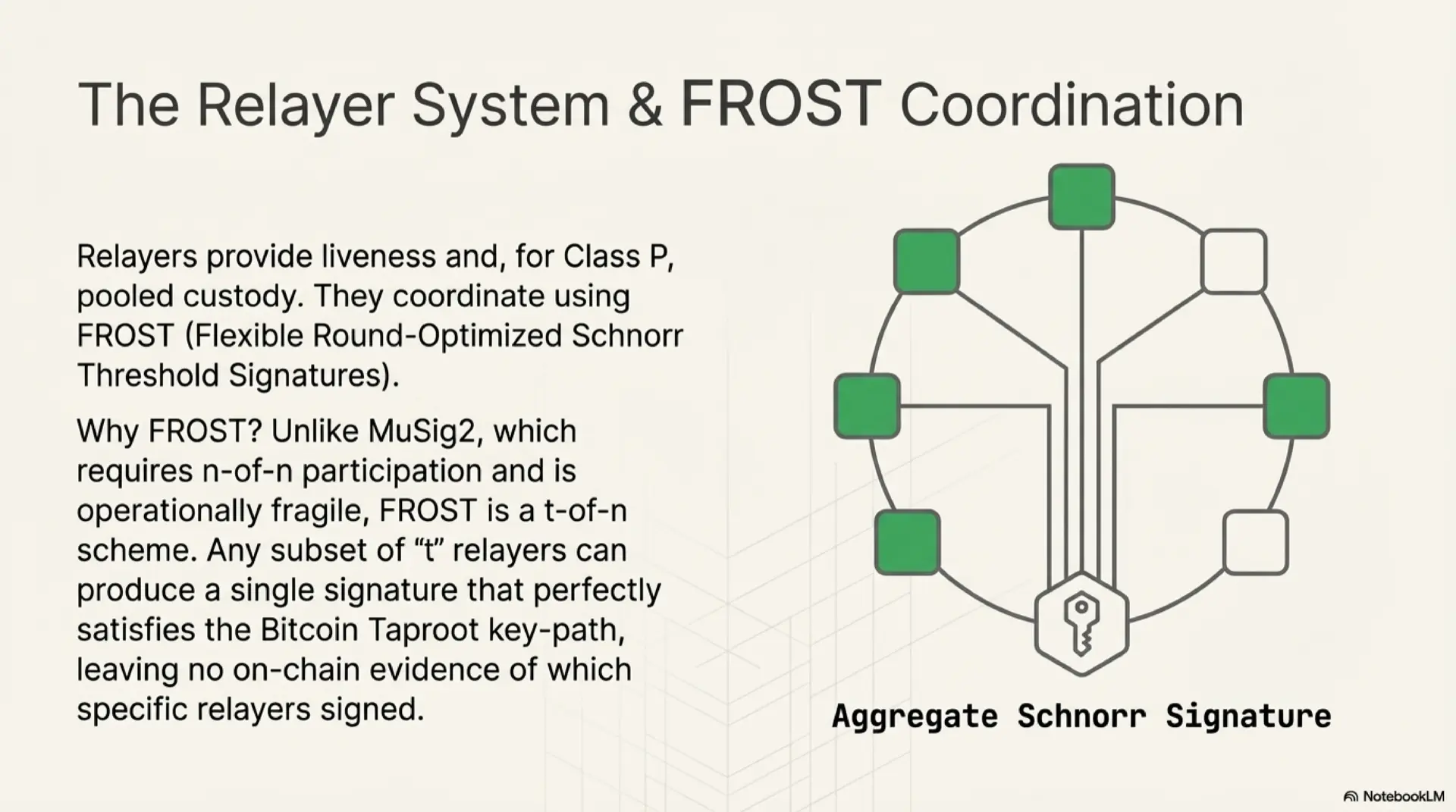
Relayers provide liveness and, for Class P, pooled custody. They coordinate using FROST (Flexible Round-Optimized Schnorr Threshold Signatures). Unlike MuSig2 which requires n-of-n participation, FROST is a t-of-n scheme. Any subset of t relayers can produce a single aggregate Schnorr signature that satisfies the Bitcoin Taproot key-path, leaving no on-chain evidence of which specific relayers signed.
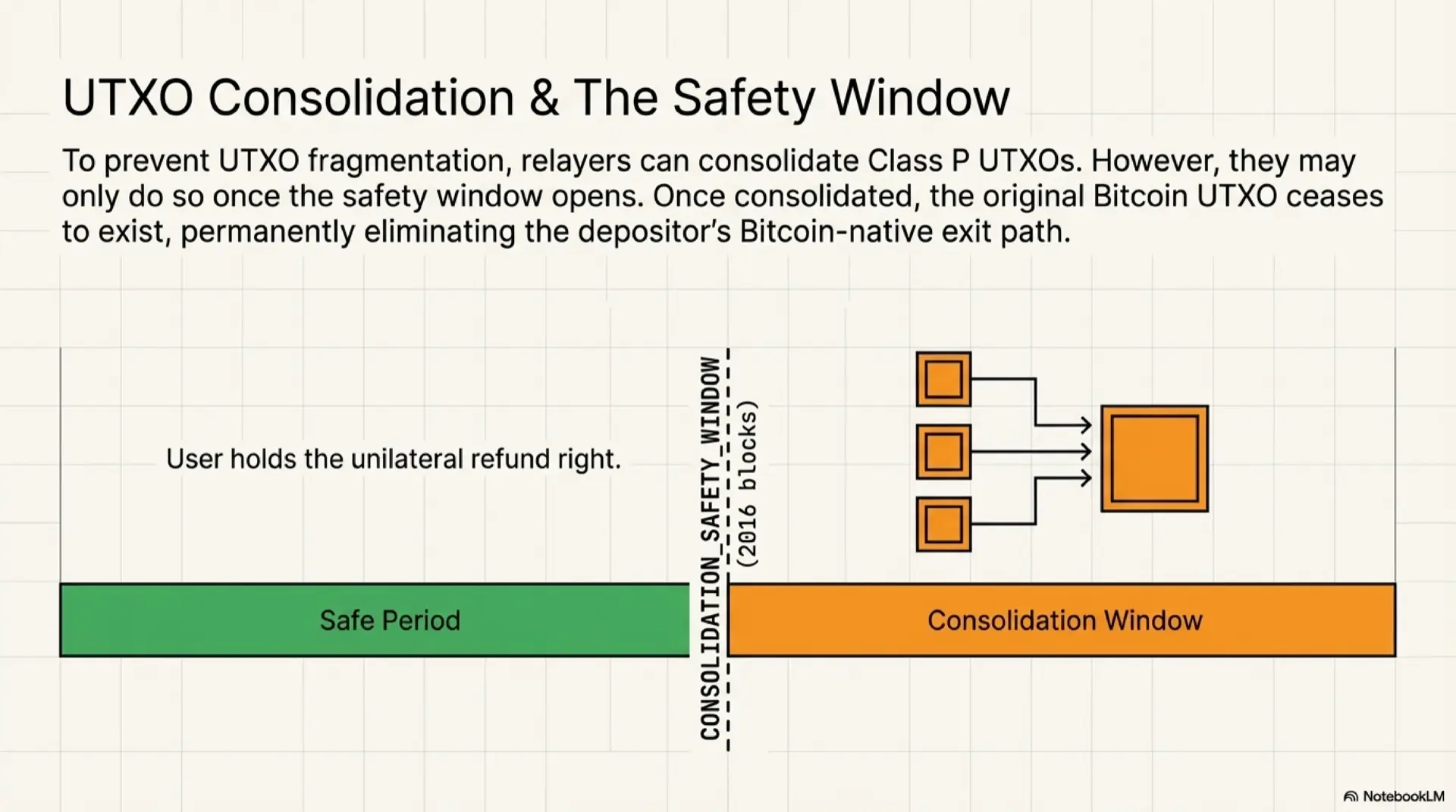
To prevent UTXO fragmentation, relayers can consolidate Class P UTXOs. However, they may only do so once the safety window opens (after 2016 blocks). Once consolidated, the original Bitcoin UTXO ceases to exist, permanently eliminating the depositor's Bitcoin-native exit path.
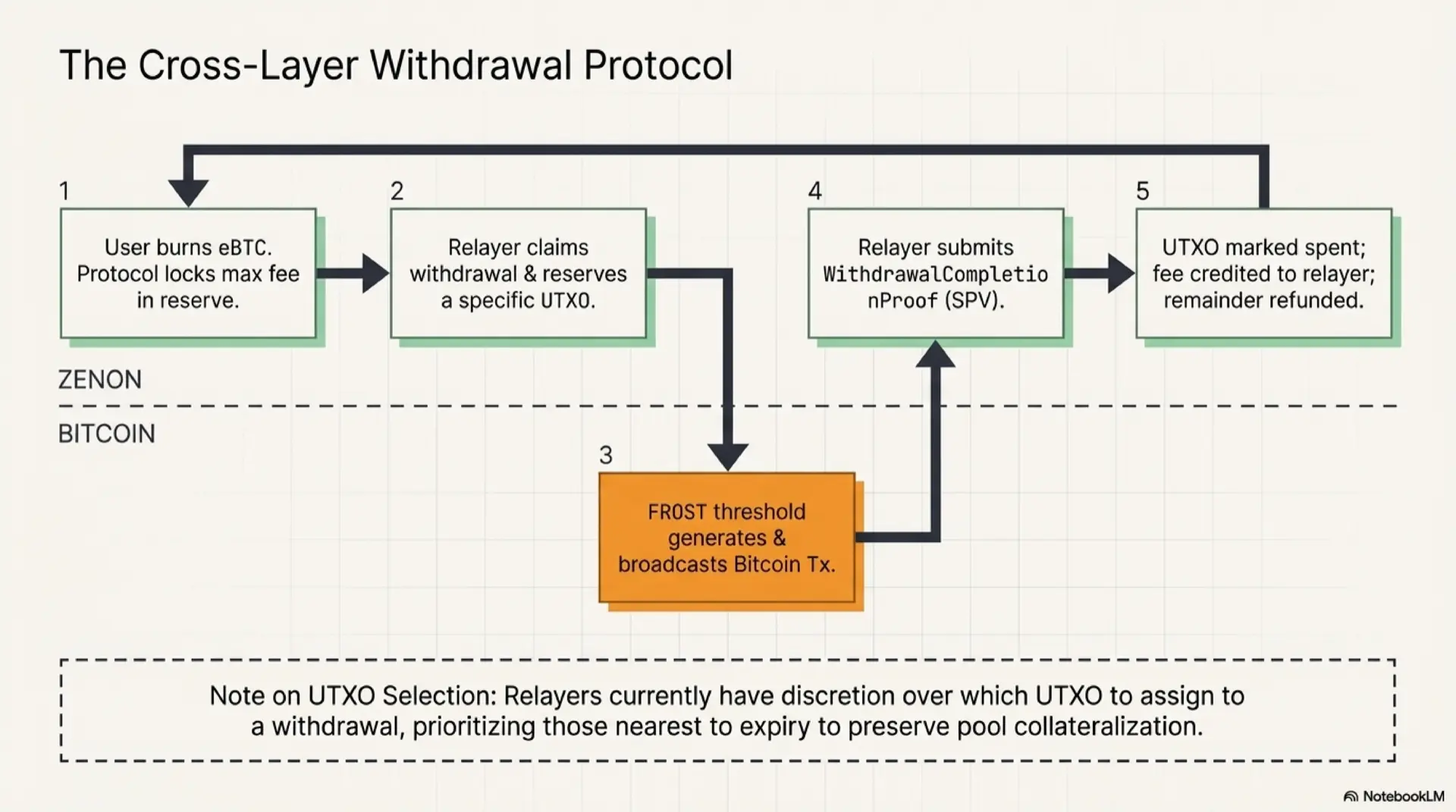
Step 1: User burns eBTC on Zenon, protocol locks max fee in reserve. Step 2: Relayer claims withdrawal and reserves a specific UTXO. Step 3: FROST threshold generates and broadcasts the Bitcoin transaction. Step 4: Relayer submits a WithdrawalCompletionProof (SPV) back to Zenon. Step 5: UTXO is marked spent, fee credited to relayer, remainder refunded.
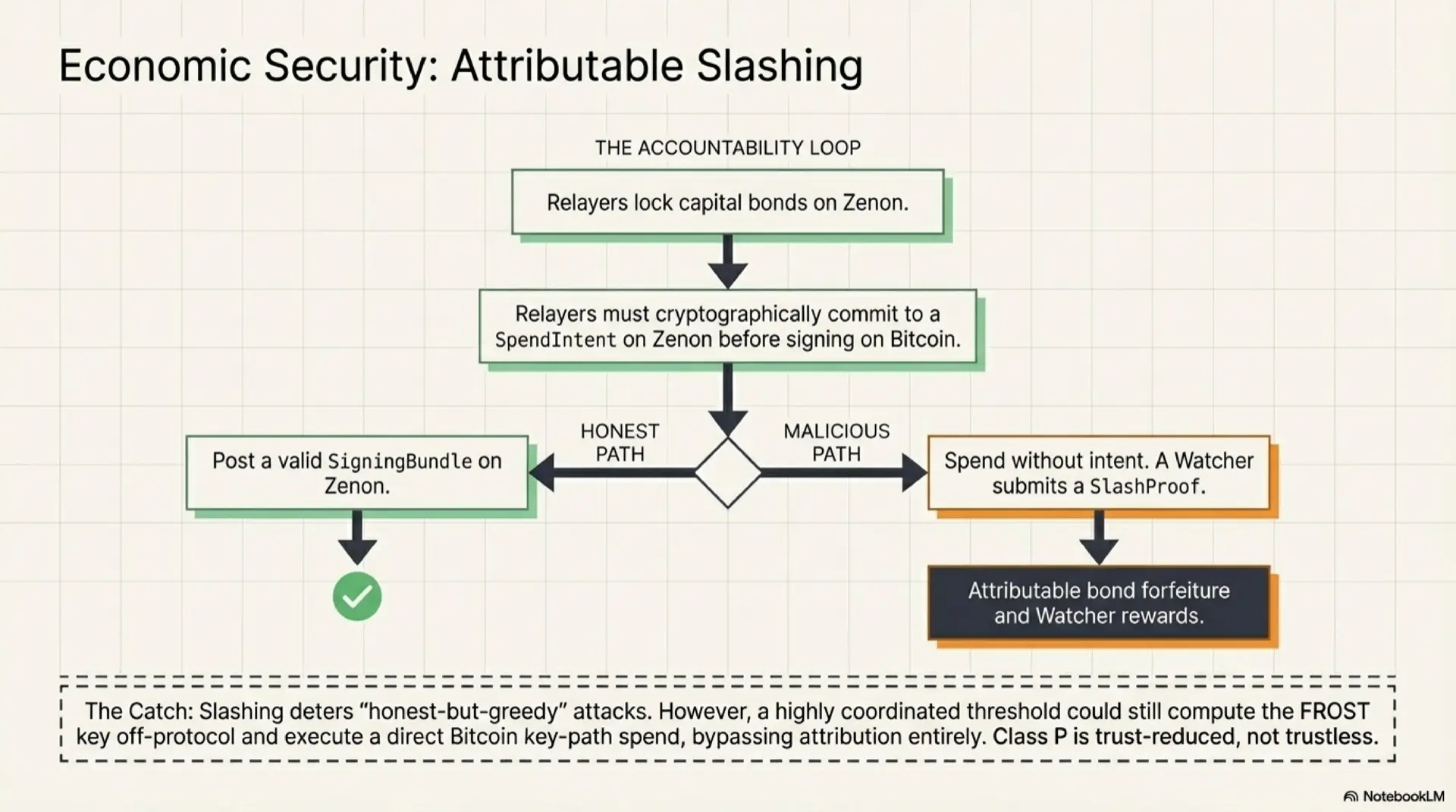
Relayers lock capital bonds on Zenon. They must cryptographically commit to a SpendIntent on Zenon before signing on Bitcoin. On the honest path, they post a valid SigningBundle. On the malicious path, a Watcher submits a SlashProof, resulting in attributable bond forfeiture and Watcher rewards. Caveat: a highly coordinated threshold could compute the FROST key off-protocol and bypass attribution entirely. Class P is trust-reduced, not trustless.
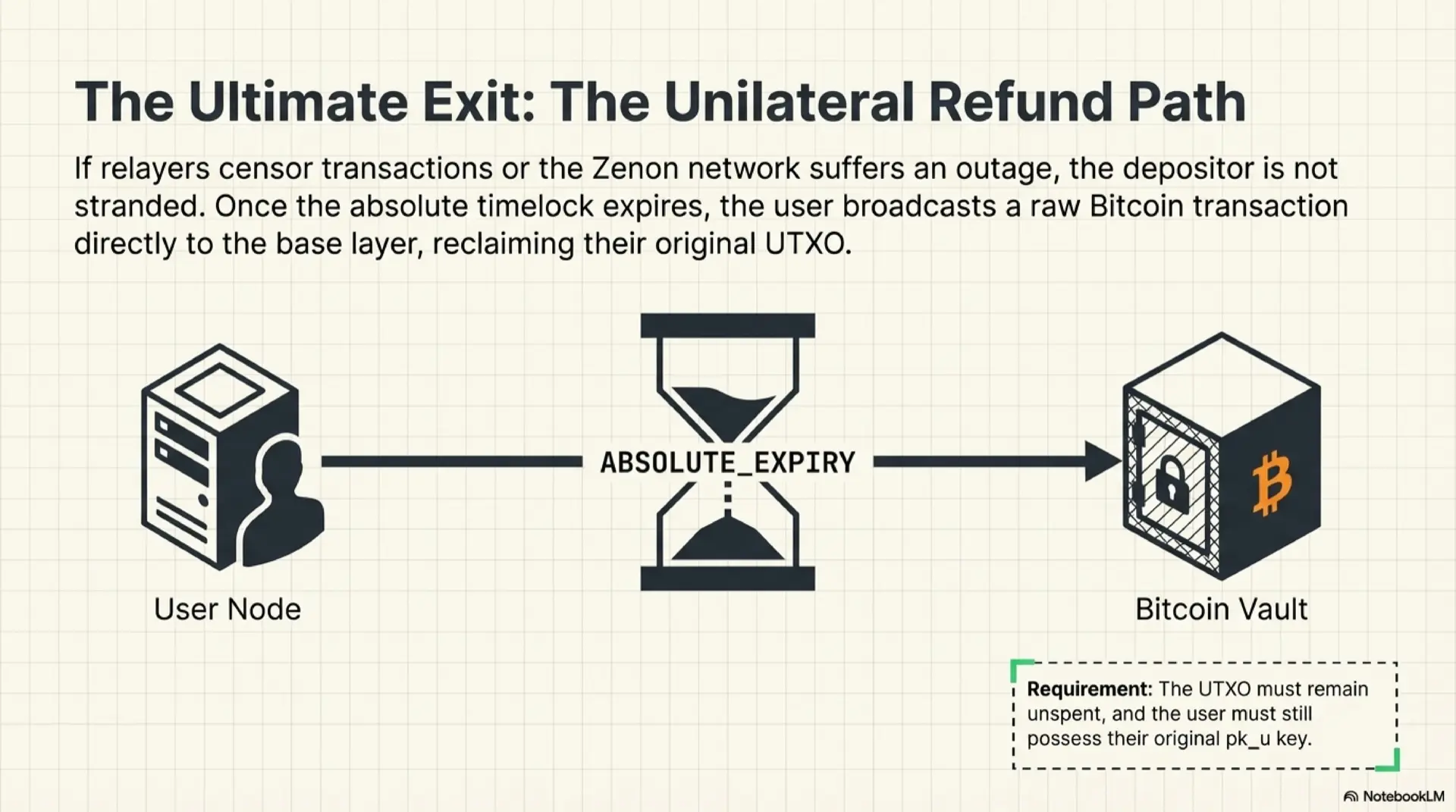
If relayers censor transactions or the Zenon network suffers an outage, the depositor is not stranded. Once the absolute timelock expires, the user broadcasts a raw Bitcoin transaction directly to the base layer, reclaiming their original UTXO. Requirement: the UTXO must remain unspent and the user must still possess their original pk_u key.
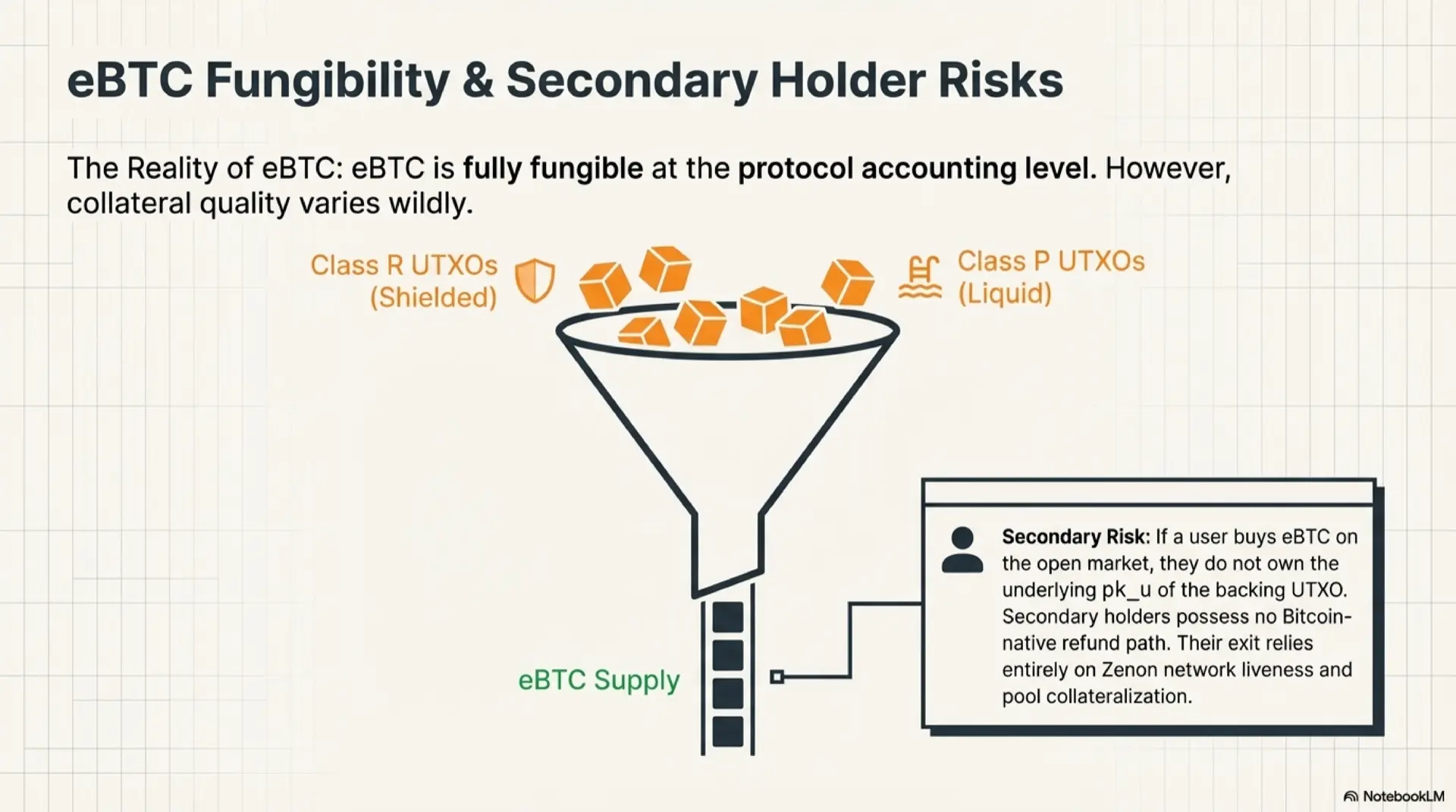
eBTC is fully fungible at the protocol accounting level. However, collateral quality varies — Class R UTXOs are shielded while Class P UTXOs are liquid. Secondary risk: if a user buys eBTC on the open market, they do not own the underlying pk_u of the backing UTXO. Secondary holders possess no Bitcoin-native refund path. Their exit relies entirely on Zenon network liveness and pool collateralization.
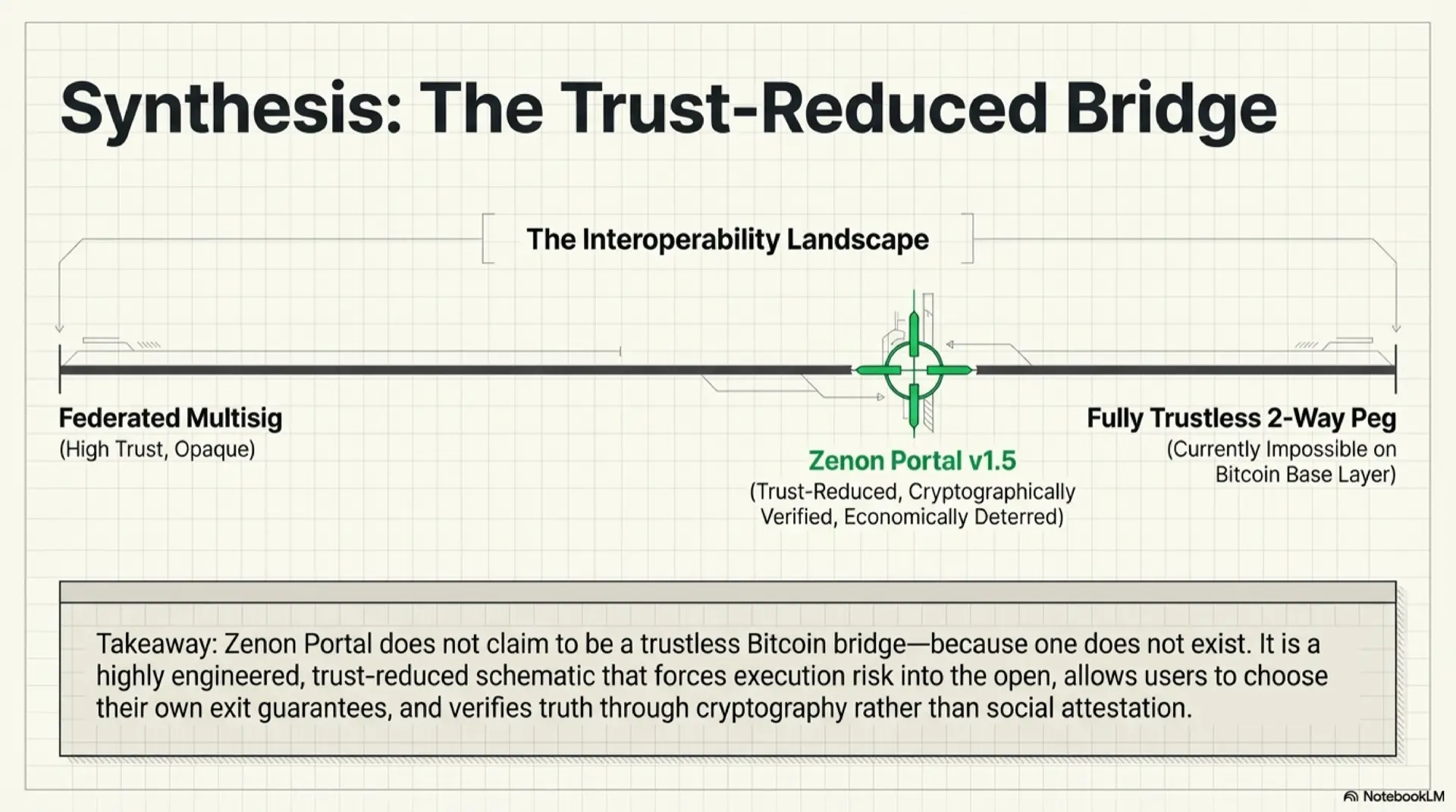
Zenon Portal v1.5 sits between federated multisig bridges (high trust, opaque) and a fully trustless two-way peg (currently impossible on Bitcoin base layer). It does not claim to be trustless — because a trustless Bitcoin bridge does not exist. It is a highly engineered, trust-reduced schematic that forces execution risk into the open, allows users to choose their own exit guarantees, and verifies truth through cryptography rather than social attestation.